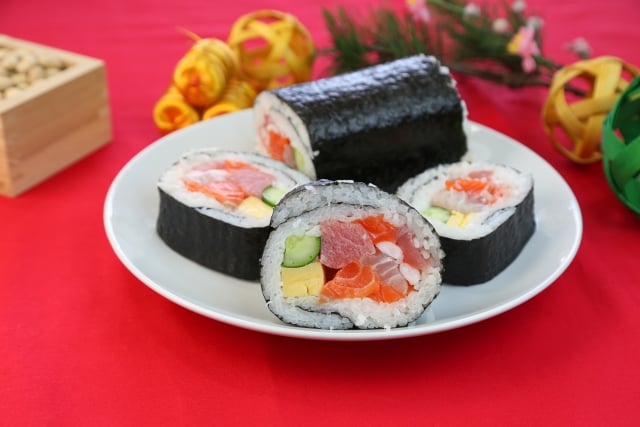


Japan has many wonderful cultures that cherish the changing of the seasons. Among these, the event called "Setsubun" held at the beginning of February is sure to appear very unique to foreign tourists.
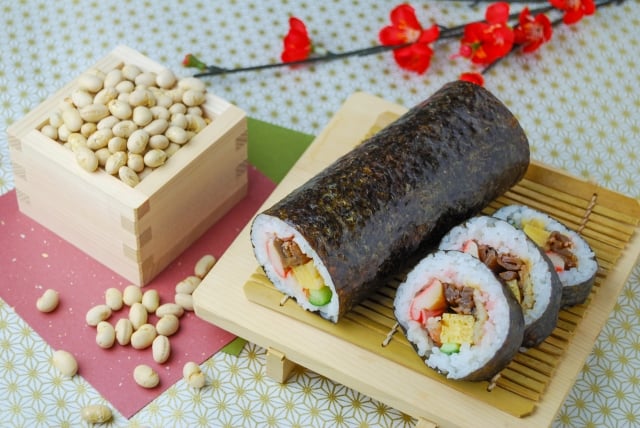
While "bean throwing" is well-known as Setsubun, there is another fun event that you should never forget: the thick, long sushi roll called "ehomaki."
In this article, we will gently explain the mysterious rules and history behind ehomaki, as well as the "Japanese spirit" that can be felt through this custom. By the time you finish reading this article, you will surely be wanting to take a bite of ehomaki with your mouth wide open.
Enjoy Japan in February! Check out our 10 recommended events and sightseeing spots!
https://tenposstar.com/ja/articles/r/2985
First, let's talk a little about Setsubun, the day we eat Ehomaki.
Setsubun literally means "dividing the seasons." In the old Japanese calendar, the first day of spring (Risshun) was considered the beginning of the year. In other words, Setsubun is "the day before winter turns to spring," and is a very important turning point, similar to what we now call New Year's Eve.
It has been believed that evil spirits, or bad energy, are more likely to enter the country at the change of seasons. Therefore, the custom of eating ehomaki to drive out evil spirits and bring in lots of happiness in the new season is still widely enjoyed in modern Japan.
There are some very unusual rules to follow when eating ehomaki that don't apply when eating other sushi. If you eat it without knowing this, you might miss out on your good fortune. Please remember this.
Rule 1: Eat facing the lucky direction of the year
"Eho" is the direction that is considered the most auspicious, where the god who governs the fortunes of the year (Toshitokujin) resides. This direction changes every year.
Japanese people use a compass app on their smartphone to find the exact direction, and then gaze intently in that direction while eating sushi. This is an important posture for facing the gods and expressing gratitude.
Rule number two: Eat the whole thing without stopping
Ehomaki is not cut into pieces with a knife. It is eaten as a single long stick, with one end taken a big bite.
This is meant to convey the idea of "not cutting ties," as it is believed that cutting sushi will lead to "cutting" good luck and connections with important people. The key to grabbing good fortune is to stuff your mouth full and eat it all without stopping.
Rule 3: Remain silent until you finish eating
This may be the most difficult rule: once you start eating your ehomaki, you must not say a word until you have swallowed the last bite.
This is because it is said that if you talk, "luck will escape through your mouth." People quietly and earnestly savor their sushi while silently reciting wishes in their hearts, such as "May I be healthy this year" and "May I meet wonderful people." The sight of the whole family eating thick sushi rolls in complete silence is somehow mysterious and heartwarming.
Why is Ehomaki so thick? It has to do with the types of ingredients inside.
Traditional ehomaki generally contains seven types of ingredients, which is a reference to the Seven Gods of Fortune, or Shichifukujin, who are seven gods of happiness that appear in Japanese mythology.
Kanpyo: Its long, thin shape represents a wish for longevity.
Cucumber: As its name suggests, it is said to bring about "nine benefits."
Datemaki and tamagoyaki: Yellow evokes the image of gold and brings good fortune.
Eel (or conger eel): Its long shape symbolizes "success" and "permanence."
Sakura denbu: A pink filling made from sea bream and other fish. It creates a festive red and white color scheme.
Shiitake mushrooms: They are believed to provide protection as they resemble the jinbaori (battle hats) worn by samurai in the past.
Shrimp: I wish for good health and that I will live long enough to bend my back.
By tightly "wrapping" these seven "fortunes" in seaweed, you can take happiness into your body with every bite.
In recent years, ehomaki in Japan has become surprisingly diverse, with more than just traditional ingredients.
If you go to a department store, supermarket, or convenience store, you'll see rows of beautiful rolls that look like works of art.
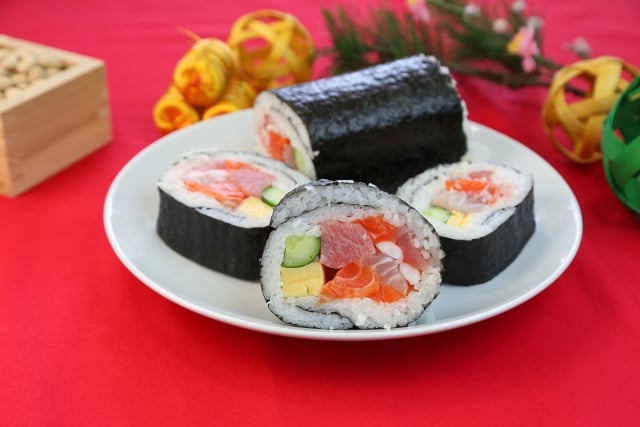
Seafood Ehomaki: Our most popular style, filled with a generous amount of tuna, salmon, salmon roe, and more.
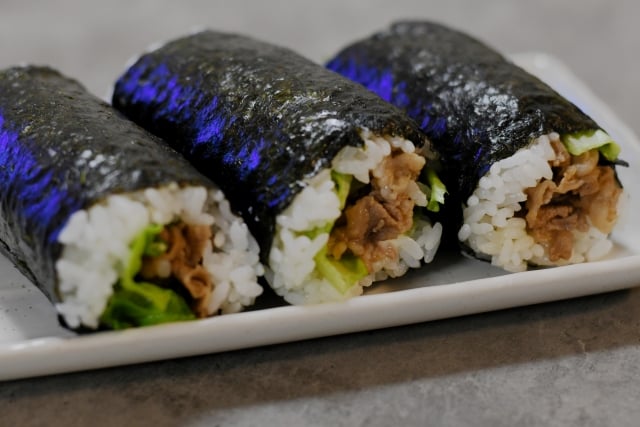
Western-style Ehomaki: This roll contains roast beef, avocado, and cream cheese, and is perfect for meat lovers or those who want to eat it like a salad.
Sweet Ehomaki: There is even a roll cake that looks just like an Ehomaki, made with black crepe dough instead of seaweed and filled with fresh cream and fruit.
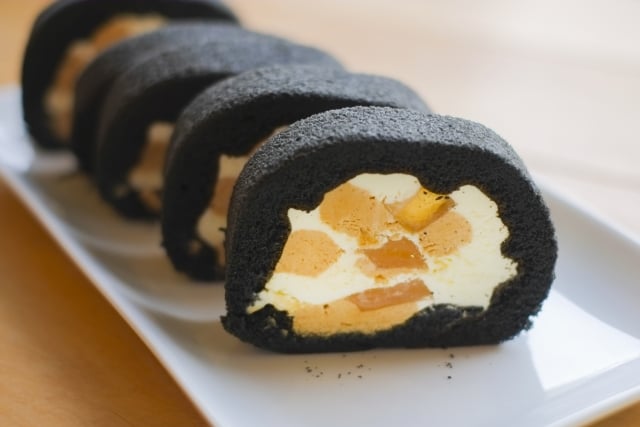
For foreign tourists, we highly recommend the "Seafood Ehomaki," which uses plenty of fresh fish. You can enjoy both the deliciousness of fresh Japanese seafood and good luck charms all at once.
If you're in Japan at the beginning of February, it's very easy to get your hands on ehomaki.
Convenience stores: Easy to purchase, even for one person.
Department store basement (depatichika): There are rows of gorgeous ehomaki rolls made by long-established sushi restaurants and high-end shops. It's fun just to look at them.
Sushi restaurant: Sometimes a chef will roll freshly ehomaki for you at the counter.
On Setsubun day (usually February 3rd), many stores set up special corners and the whole town is filled with the "Ehomaki" mood.
The custom of eating ehomaki gives us a glimpse into the wonderful spirituality of Japan.
It is the kindness of "giving a wish in a tangible form."
Rather than simply wishing to be happy, the Japanese way of eating involves gathering seasonal ingredients, creating special rules, and enjoying meals. By doing so, they add color to their daily lives and create energy for tomorrow.
You can also sense the importance of valuing the seasons.
The cold winter is almost over, and the warmth of spring is on its way. We should celebrate this small change and not forget to be grateful to nature. The act of eating ehomaki is like a ritual that reminds us that we humans are also part of nature.
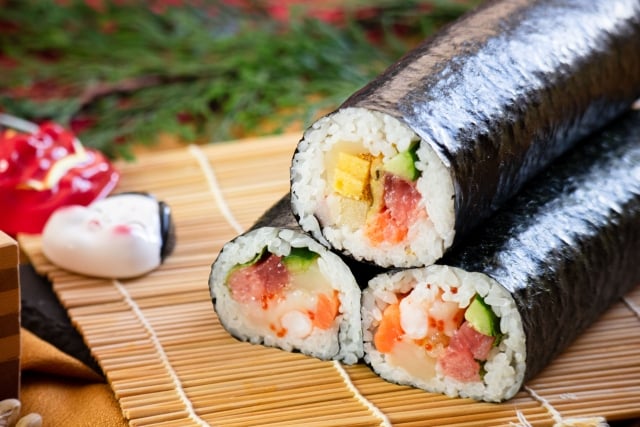
If you visit Japan during Setsubun in February, be sure to research the lucky direction and buy a large ehomaki.
Gazing at the compass, making a wish in your mind, and above all, enjoying your sushi in silence.
That one bite contains not only your own happiness, but also your wishes for the longevity and peaceful future of your loved ones.
The rules may seem a little difficult at first, but the refreshing feeling you'll have after finishing your meal will be an irreplaceable "special experience in Japan."
Spring in Japan is just around the corner.
We sincerely hope that this heartwarming culture of ehomaki will add even more color to your journey and bring you wonderful good fortune.
Check out the deep world of matcha: a journey through a thousand years of history
https://tenposstar.com/ja/articles/r/3812